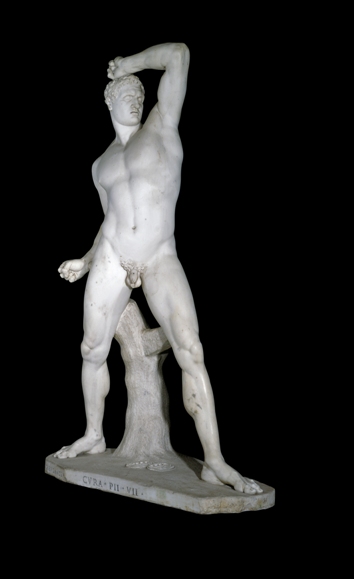
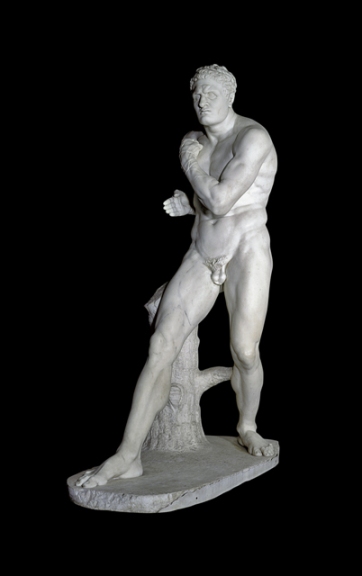
Classical Pugilists Creugas and Damoxenos by Canova

EKTA SCANSIONATA DA TRECCANI (ISTITUTO ENCICLOPEDIA ITALIANA)

Inventory Numbers: 968-970
EKTA SCANSIONATA DA TRECCANI (ISTITUTO ENCICLOPEDIA ITALIANA)


These two wonderful and powerful statues of pugilists, created by Antonio Canova, are featured alongside the statue of Perseus in one of the most important locations of the Vatican Museums: the Octagonal Courtyard. The most important statues of the Vatican’s collection are on display for the public here every day. Historically, the Octagonal Courtyard was the first place chosen by Pope Julius II to host his collection of Classical Antiquities.

At the end of the 1700s, Canova decided to work on two statues inspired by classical models from ancient times. Thus, between 1794 and the following year he completed the statues of two boxers inspired by a story titled the Periegesis of Greece written by Greek traveller Pausanias.

Shown here are the two pugilists, named Creugas of Durres and Damoxenos of Syracuse, who met during the Nemean Games. According to legend, the two were so evenly matched that the competition lasted for hours without a decision. When there was no foreseeable end, both men agreed to take a single, undefended blow from the other. Creugas delivered the first punch, striking Damoxenos on the head. Damoxenos, struck Creugas on the side and tore out his intestines. The Argives disqualified Damoxenos, for killing his opponent and Creugas was posthumously declared the winner.

In 1795, Canova began working on the preparatory drawings of these subjects for sculptures. A year later, in 1796, both models were ready. The following year, Canova began the marble statue of Creugas, which was completed in 1801. In 1802, the two statues, along with the Perseus, were purchased by Pope Pius VII. Three years later, Canova developed a second model for the Damoxenos.

The Pope purchased Canova’s statues in an effort to replenish the Vatican Museums that suffered heavy losses during the French occupation. Many of the masterpieces from the Vatican Collection had been taken to France in 1798. Pius VII’s act of purchasing these statues was very important at the time, because it proudly reaffirmed a policy of national prerogatives, despite the robbery of those treasures inextricably linked to Rome. These pieces are expected to be returned on display in the Octagonal Courtyard.
Bronze Crucifix by Pericle Fazzini

Inventory Number: 23983

23983LR


Pericle Fazzini was born on May 4th, 1913 in Grottammare (Marche) where he became interested in sculpture at a very young age. Between 1931 and 1933 he revealed his style remarkably with beautiful works such as the Woman walking on the water (1932), which won him the “pensionato artistico nazionale”. The Portrait of Birolli was another of his debut pieces which, although it was influenced by the teachings of A.Martini, is highly characteristic of Fazzini’s originalityand freshness.

In 1934, he exhibited his work in Paris with Despiau, Bonnard, De Segonzac and Cagli. Afterwards, he participated in all major national exhibitions such as the Venice Biennale, and the Quadrennial of Rome, presenting works such as the Portrait of Ungaretti and the Boy with Seagulls (1940-45 ). During this period, he demonstrated his unsurpassed expertise in working with wood. His standing Portrait of Anita (1939), also made ​​of wood, won him the Turin Award in 1947. In the second half of the 20th century, during the spread of a renewed interest in cubism and abstract art in Italy, Fazzini fully developed his style. His work was created out of his amazing, instinctive nature, and each piece was characterized by a mix of creativity, imagination and unconventionality.

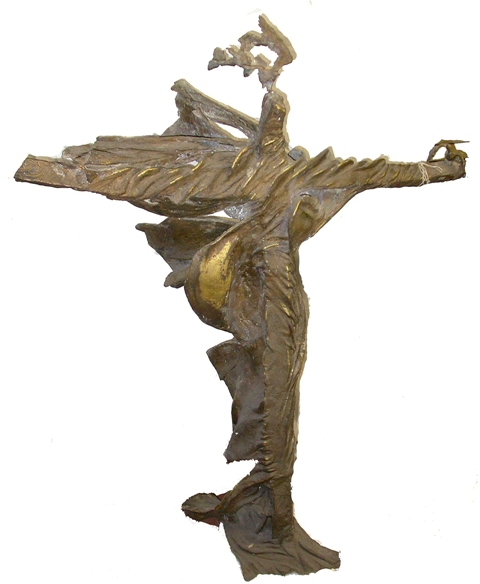
This wonderful cross was completed by Pericle Fazzini in 1974, at the same time as his completion of the Resurrection of Paul VI Hall at the Vatican. Fazzini’s depiction of the cross without Christ, offers his own very personal reflection. The Shroud alone is depicted, blown powerfully against the cross by a strong gust of wind; a small bird miraculously resists, perched atop the cross itself. It is thought that the bird might be a robin, which, according to legend, was the only bird, among the many still in the air when Christ was dying, to stop and remove a thorn from the head of Jesus. A drop of the blood of Christ dampens the feathers of the Robin’s breast, and as a way to remember its act of love, Jesus transformed the robin’s breast to be forever red.

On the back of the cross an inscription reads: “Always, the wind blows and slams against your embedded cross, dominating time in this land. The wind makes to beat and stagger it like a coat hanger. ”

This crucifix represents an advanced stage in a progressive evolution towards formal abstraction in the art of Fazzini, which began in the late fifties. His style is, however, continuously characterized by a constant dramatic tension and dynamism, so often infused into each of his pieces that the poet Giuseppe Ungaretti called him “the sculptor of the wind.” This piece is expected to return on display after a brief time in storage.

Wooden Door with the Coat of Arms of Pope Urban VIII Barberini

Inventory Number: 51510


This notched door opens into the Room of Constantine from the north side, providing access to the Stanzino of Urban VIII, a small room bordering the Room of Charlemagne in the Apartment of Julius III. From the Stanzino, a second door opens onto the external walkway that connects the Room of the Fire in the Borgo with the Room of Constantine.

The Stanzino was renovated in 1632 at the behest of Pope Urban VIII Barberinii (1623-1644), who used it as his private room during papal audiences, which he held in the surrounding rooms.

In memory of his patronage, a decorative inscription in polychrome stucco was applied at the summit of the wall—two coats of arms with the Barberini symbol of three heraldic bees, topped by the papal tiara and keys, are joined by an inscription, divided in four parts, which reads: PRIVATAE PONTIFICVM COMMODITATI / URBANVS VIII PONT.MAX / ANNO SALUTATIS MDCXXXII / PONTIFICATVS DECIMO.

At this time, Pope Urban also commissioned the beautiful notched door. The wooden portal consists of a single door made from walnut, divided into six panels that are exclusively decorated on the interior side, facing the Room of Constantine.

Each of the two highest square panels feature the Barberini crest – a shield with bees – framed by a geometric decoration of ribbons and scrolls, carefully done using the technique of tracery. The two small horizontal panels in the center are adorned by leafy masks with laurel branches—another Barberini symbol—coming out of their mouths. The two lower mirrored panels remain undecorated.

The door of the Room of Constantine was crafted by an unknown master carver who, instead of signing his own name, followed the Vatican Palace’s custom of inscribing the name and insignia of the Papal Patron into his work. Thus, this valuable piece of sculptural and carved workmanship celebrates Pope Urban VIII, featuring the distinctly Barberini heraldic bees and laurel branches to symbolize and materialize his glory. This piece is expected to be returned on display in the Raphael Rooms, where they are housed today.

11 month Patrons’ Office Fellowship

Foto digitale


As the Patrons of the Arts continues to grow and expand, the number of projects, events, and visits from our beloved Patrons does too. In order to keep up with this increased activity, our Vatican office has created a new role—the Eleven Month Patron’s Fellowship. Since its launch in 2010, this special position has become a crucial part of our Vatican office operations. The longevity and commitment of this position, as opposed to the short, sporadic terms of our volunteer intern program, affords the office an essential level of continuity and the fellow, him/herself, a more comprehensive work experience.

During the course of the year, the one-year intern functions mainly as the visits coordinator, handling all aspects of arranging the daily tours and visits of Patrons from all over the world. This alone allows them to exercise and develop their Italian language proficiency, learn more about the Museum’s structure and operations, hone their writing and communications skills, and experience the public relations aspect of working in a nonprofit organization. The year-long intern greatly helps our office in handling its duties, functioning as a reliable member of the team, adopting long term responsibilities and projects. The position enables the Patrons of the Arts to expand, continue, and improve upon our special development projects, from our e-newsletter, social networking platforms, and website to our online fundraising through CrowdRise and content management systems.

Additionally, the office fellow will have the opportunity to develop a familiarity with the office and have a stronger relationship with our patrons through a variety of events, tours, and daily interactions. They will be able to develop a level of Italian language skills at which they can communicate reliably with the Museum Staff and Vatican City community. This sponsored intern would be able to join the Patrons Office team earning valuable experience with the Vatican Museums, the mission of the Catholic Church, and a non-profit organization. Overall, they gain many valuable experiences throughout the term, from writing and compiling our biannual newsletter to even translating and editing restoration reports.

In turn, this intern is expected to serve as the sponsoring chapter’s personal liaison in Rome, available for everything from restaurant recommendations to exclusive guided tours in order to enrich their visit experience. Throughout the year, the Patrons are guaranteed added support from an experienced extra hand, one who will be familiar with the workings of Vatican City, the Museums, and the office itself.

This sponsorship ensures that the high standards of service to our Patrons are met by the Patrons Vatican office, all the while creating the opportunity of a lifetime for a deserving candidate to experience the legacy of the Vatican Museums Collection firsthand while working for an amazing cause, furthering the mission of the Patrons of the Arts.

After calculating the basic living expenses for an intern over a twelve month period in the city of Rome, we propose the following price for a chapter to sponsor this invaluable position. As it has been in the past, the internship would be named after the sponsoring chapter.

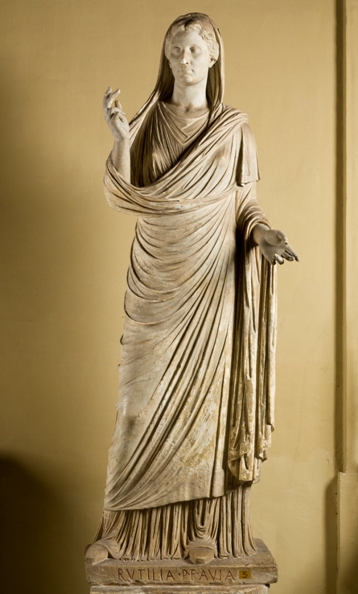
Statue of Rutilia Mater and Statue of Rutilia Avia

Inventory Numbers: 1695, 1696


Inventory Numbers: 1699, 1700

Foto digitale

These two female statues were discovered at Tusculum in the Albani hills during the excavations of Luciano Bonaparte (1809). They were sold a few years later to Pope Pius VII Chiaramonti. Bonaparte’s excavations brought a number of marble structures to light. He unearthed the theater and the piazza of the forum, allowing scholars to definitively identify this place as the city of Tusculum, which was often noted by ancient literary sources. The famous Latin orator Cicero mentioned a villa named Tusculanum, one of his residences which he particulary cherished.

As stated on the inscriptions carved on the plinth, the statues represent Rutilia mater, the daughter of Lucio, and Rutilia avia, daughter of Publio. These sculptures, both made from marble, are dated back to the Augustan age. It is likely that they were a part of a larger series that was mounted in an important public space to honor the gens Rutilia, a prominent Tuscolan family of the first imperial age. As often occurred in Italian towns and municipalities, the Augusto-Tiberian age brought to Tusculum new styles and decorative techniques for building public monuments, such as the theater and the buildings. These new buildings were used by the royal family and eminent local gentes to perpetuate their propaganda and self-glorifying messages. Alongside the depictions of the Rutiliae were also statues of the male representatives of the family, likely flanking statues dedicated to the principal members of the imperial family of Augustus.

Since their arrival at the Chiaramonti Museum (1821), the two statues have been displayed as we see them now. The funerary altar is dedicated by Caius Vettius Zoticus to his beloved wife Vettia Pharia. The inscription is framed by grooved colonnades, atop which sit Ionic capitals. Above the tablet that holds the epigraph, two ram heads face each other and, at the center, stands a gorgoneion. On the sides are the common symbols of libation: on the left, a little pitcher (urceus) and at the right, a patera. The altar, which dates to the beginning of the 2nd Century AD, was recorded in the Giustiniani collection in 1635 after having been donated by Antonio Canova to Pope Pius VII Chiaramonti.

The statue of Rutilia avia stands on a molded base from the Imperial Age. It bears an inscription which indicates that it is dedicated to Hercules. The base was in the Giustiniani collection and was donated to the pope by Antonio Canova at the beginning of the 19th Century. These two pieces are expected to return on display in the Chiaramonti Gallery.

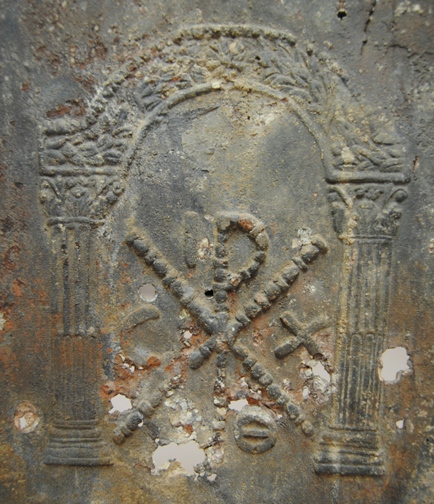
V Century Chi Rho Relief from Middle East

Inventory Number: 57214

57214.detail. Chi Rho frangment LO RES


This precious decorated lead plate was given to Pope John Paul II by the President of the Republic of Lebanon on March 2, 2001. The gift has greatly enriched the Pio Cristiano Museum collection because it gives important archaeological evidence of primitive Christianity in the Middle East. The 5th Century slab originally made up the side of a lead sarcophagus from the region that is now Syria and Lebanon. Evidence of this type of sarcophagus has also been found in the Western world, especially between France and northern Italy. This sarcophagus demonstrates particularly oriental features, such as the rich “embossed” decoration on all of its sides. The sarcophagi of this period are often found with similar lids: either a curved lid or a flat lid, as is shown here.

This piece is ornately decorated by a niche formed from two Corinthian columns, fitted with bases and supporting an arch. This decorative technique frequently occurs in pieces from this period, particularly on funerary monuments. The niche was generally used as a cornice for further adornment, increasing the

aesthetic value of the tomb. The majestic architecture and images depicted on the sarcophagi of the 5th century are often interpreted as references to the “Celestial Realm” that awaited the faithful at the end of their mortal life. At the center of the niche pictured here, a “Christological monogram” is formed by the combination of Chi and Rho, the first two letters of the name of Christ in Greek. This sign is historically recognized as the one that appeared to Emperor Constantine (306-337) during his prophetic vision. Since then, the symbol has been used in all artistic representations of ancient Christianity as a symbol of the Resurrection of Christ and Christians. Around this central monogram, other Greek letters form the word ΙΧΘΥC (“fish”). These symbols represent the Greek phrase “Jesus Christ is the Son of God, the Savior!” – further testimony of faith in Christ and the Resurrection. This piece is expected to return on display in the Pio Christian Museum.


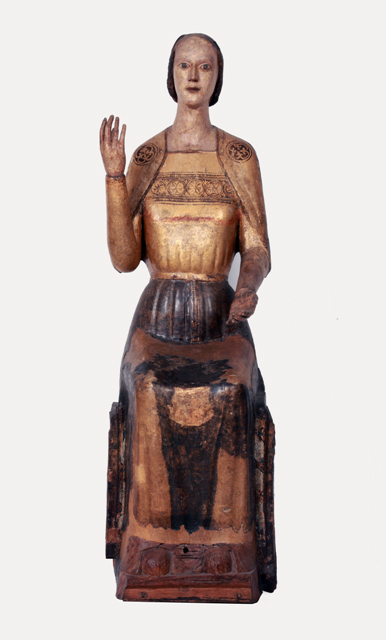
Richly Gilded Wooden Statue of the Virgin Mary

Inventory Number: 42376

FOTO DIGITALE


This beautiful wooden statue joined the Vatican Museums’ collection in 1978.

It depicts the Virgin Mary holding the Baby Jesus in her lap in a configuration common to the well known iconography of the 14th Century. This particular form of iconography developed at the end of the Middle Ages, and influenced many styles of painting and sculpture. The Virgin was usually seated like a queen, holding her child with an aura of regal dignity and maternal affection. Her gesture of blessing was a common position for this type of statue. In this wooden sculpture, the Virgin Mary sits on an imposing throne, which was originally decorated with small arcades and a central column in stucco. A study of her hairstyle revealed that she once wore a crown, but this adornment has unfortunately been lost. The statue was carved from one piece of chestnut wood and the inside was hollowed out in order to make transportation of the piece easier. This piece is expected to return on display after being held temporarily in storage.

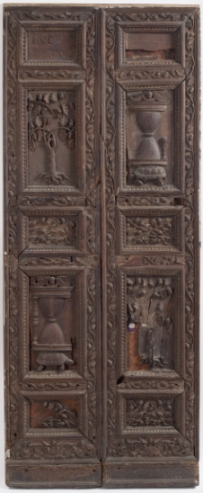
Two Sets of Double Doors with Inscriptions of Lucretia della Rovere

Inventory Number: 53839

FOTO DIGITALE

Inventory Number: 53850

The two double doors of walnut wood, each one divided into five panels, were carved and inlayed by an unknown cabinet-maker in the first half of the 1500s.

In the upper panels, the name of the commissioner Lucrezia della Rovare: LVCRE/TIA RVVE/RE is displayed in Roman capitals and designed in the inlay. In the lower frames, there is a carving of the herald emblem of the oak, otherwise known as the rovere. Another detailed carving of a tortoise carrying an hourglass on its back symbolizes slowness, prudence and wisdom, emphasizing the importance of using time well.

Lucrezia della Rovere was born in 1485 and died at the age of 67 in 1552, as is mentioned on her tombstone at Trinità dei Monti in Rome. Her mother was Luchina della Rovere, niece of Pope Sixtus IV della Rovere and sister of Pope Julius II. Luchina had two marriages: the first with Gabriele Gara di Savona who died in 1479 and the second with banker Giovanni Francesco Franciotti di Lucca, father of Lucrezia.

In 1508, the young Lucrezia married the commander Marcantonio Colonna (1470/80 -1522) as she was urged to by her uncle, Julius II. Julius II highly regarded Colonna, as he had fought with him in the campaign against Bologna, and was the one whom the pope entrusted command on October 20,1506. Guicciardini reports in the History of Italy that Julius II “complained about all the captains except Marcantonio Colonna, whom he had summoned from Modena”.

To the newlyweds, Julius II gave the building near to the church of the Santi Apostoli in the place that had belonged to the Protonotary Lorenzo Colonna. On August 21, 2025 Julius II also handed over to Marcantonio and Lucrezia the Castello di Frascati with the bull. These pieces are expected to return to display after a brief time in storage.

Precious Ceramic Plaque by Bernard Palissy

Inventory Number: 107978


The exquisite plate in polychrome ceramic is attributed to the French ceramicist and chemist Bernard Palissy (1510-1589). At the center is depicted a female figure similar to a deity in the Greco-Roman style. In her right hand she holds a cornucopia, the symbol of abundance and happiness. In her other hand she holds a crown to indicate wealth and royalty. This woman, who is partly covered by a curtain, stands below a small, winged angel and is surrounded by figures of flying animals, probably birds of prey, and masculine faces. Along the border, a series of cameos of human faces, now slightly worn away by age, enriches the decoration that is already exquisite thanks to such vivid colors.

The use of animal representations, a characteristic particular to Palissy, was often used in relief work. Very much in vogue at the end of the 1500s, this artistic trend spread throughout Europe, gaining popularity especially in French salons.

Catherine de Medici, Queen of France was a great admirer of Palissy, to the point that she commissioned him to design a private grotto in her garden near the Palazzo delle Tuileries in 1564. On the back of this piece is a paper label with the writing: “Plate provenient da l’ancienne Abbaye de Bégard” (Plate originating from the old Abbey of Bégard.) Currently the Ethnological Museum is under renovation, but it is expected that this piece will return on display in the near future.

13 Antique Terracotta Vases from the Regolini Galassi Tomb

Inventory Numbers: 36584, 85; 36588-36597; 36608

Scansione da ekta (10x12 cm) n 17788

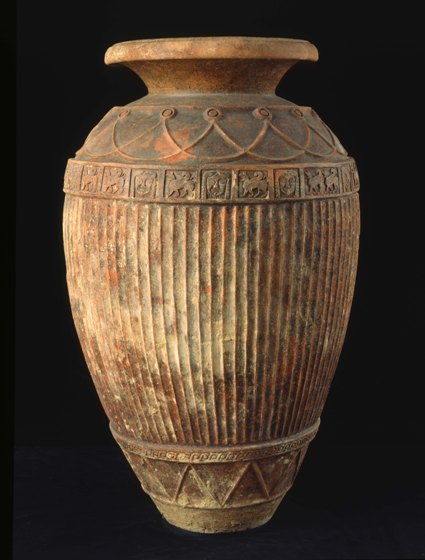
This amazing project aims to restore the precious artifacts originally located in the Regolini Galassi Tomb such as ceramics, bronze and silver vessels.

In 1836, at the necropolis of Sorbo in Caere (modern day Cerveteri), Archpriest Alessandro Regolini and General Vincenzo Galassi excavated one of the richest and most representative Etruscan tombs ever discovered, dating to between 675 and 650 BC. Some of the objects found in this important archaeological site are on display in Room II of the Gregorian Etruscan Museum.

This tomb is one of the most important pieces of evidence from the phase called the Orientalizing Period, a cultural phenomenon that swept across the entire Mediterranean basin. This movement brought with it a wide circulation of goods and knowledge from Egypt and the Near East due to the activity of the Phoenician and Greek merchants.

In the antechamber there was a burial bed, decorated and surrounded by weeping bronze statuettes, a trolley of gifts, bundles of bronze and iron skewers, ornate furniture, and vases depicting an aristocratic banquet. Eight embossed bronze shields were placed along the walls as symbols of rank and prestige, alluding to the chariot, the prerogative of the prince-warrior. Also found in the antechamber was a wagon, which was likely used for the last trip to the funeral ritual, and a carriage used both in everyday life and in ceremonies.

In addition to lavish bejeweled outfits, vases, and metal décor, the tombs of the Etruscan princes were also filled with a number of large containers to store goods and food to be used in the afterlife. Another item commonly found in the tombs were braziers, a ritual object that carried burnt offerings to accompany funeral ceremonies. Large containers made of mixed ceramic were also discovered in the Regolini-Galassi tomb. Their discovery led to further discoveries of other monumental tombs in the same necropolis. These funerary objects like braziers and pithoi often depict fantastical animals inspired by oriental tradition. They date back to the end of the 7th century BC, and are, therefore, older than the main sepulcher of the Regolini-Galassi tomb. The restoration project is rendered complex by the relative fragility and the considerable weight of these large terracotta containers that makes them difficult to transport. It will be necessary, therefore to recover and esthetically analyze each piece close-up, now nearly two centuries after their initial discovery. This study is important because objects created during the Orientalizing epoch have increased in value amongst the scholarly community in recent years. Simultaneously, researchers will create accurate graphical and photographical documentation that will be used to restore the complete image of the complex decorations. This documentation process will also be helpful in determining the location and date of creation of each ceramic piece. The restoration will also involve the cleaning of surfaces, repairing cracks and other damage and small integrations where necessary.