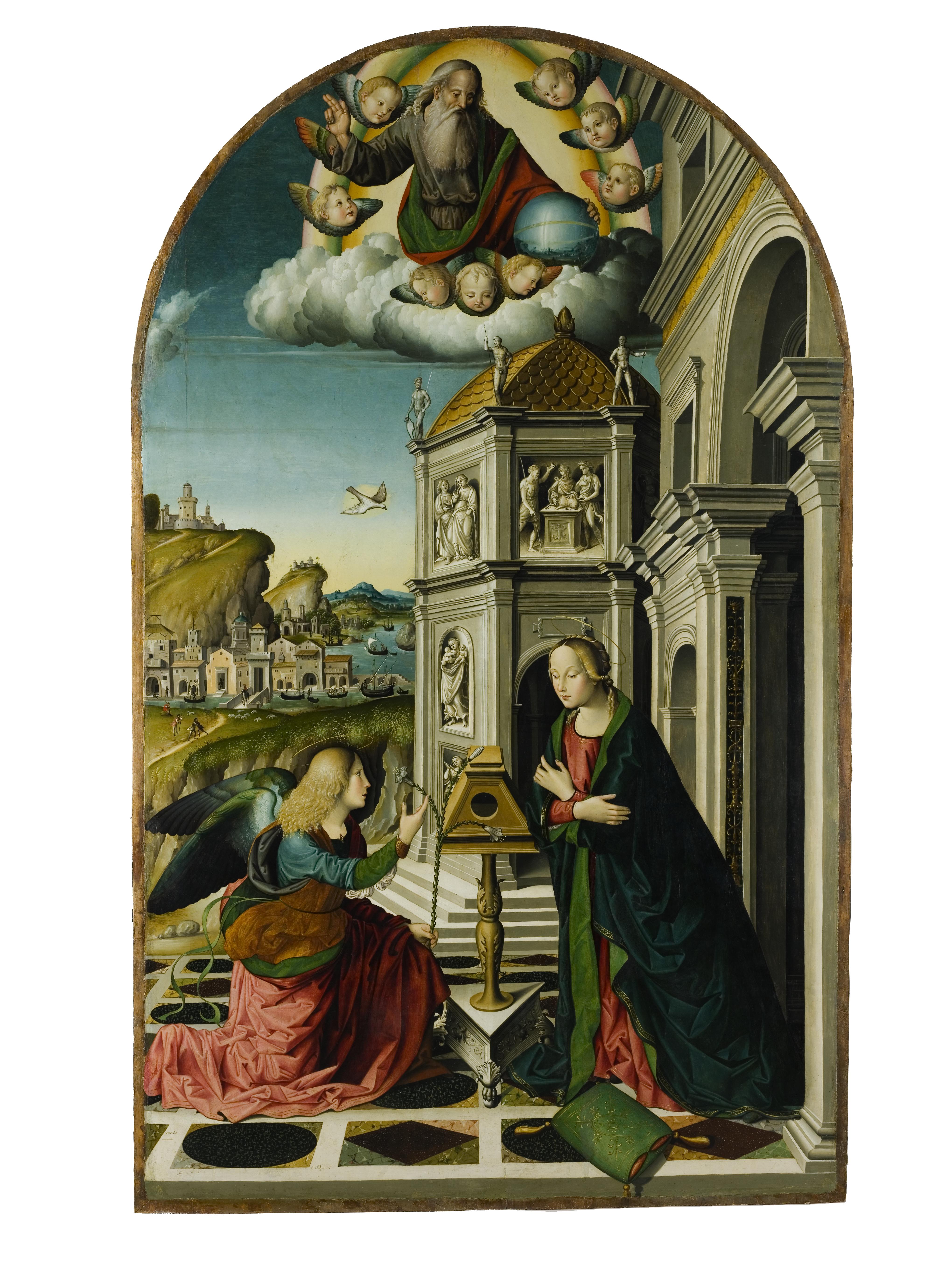
The Annunciation Near a Seaside Town by Marco Palmezzano came to the Vatican Pinocoteca in 1909 after having first been in the Lateran Pinacoteca from 1844.
The encounter of the Virgin Mary with the Angel occurs outside the entrance of a palatial portico. A seaside town is in the background. The bay is teeming with ships. A second church-like building, crowned with statues at the base of its cupola, lifts heavenward an octagonal tower decorated by ornate classical marble statues and reliefs, framing this angelic greeting in a classical setting.
The Eternal Father who is surrounded by a glory of cherubs with the earth in his right hand, watches over the Annunciation. Mary interrupts the prayers she is reciting and stands from the pillow on which she is kneeling to listen to the words of the divine messenger. On the left Gabriel, kneeling before the Virgin is profiled while his right hand holds a lily and the right is extended in a gesture of salutation. Opposite him, Mary, standing before the ambo, crosses her arms over her chest in an expression of mixed unrest, distress, emotion, and confusion.
This painting was moved to the restoration laboratories due to the peeling of the colors. The previous support was made of ten vertical axis held by three transversal pieces. The frame was fixed with a variety of “butterfly” inserts. These inserts have since caused some problems because they do not allow for the proper flexibility, thus creating new fissures and lesions on the support and pictorial surface. Multiple types of insects have also infiltrated the wood.
The pictorial surface had been darkened by a slight layer of altered varnish that had compromised a correct reading of the colours. These were located above all on the extremities of the painting. Cohesion and adhesion of the pigments were generally satisfactory, but the paint along the junctions of the panels and the unions of the axis of support was in critical condition.
The beams were damaged at several points. The butterfly inserts were also deformed and damaged, thus causing new cracks in several places. Subsequent signs of deterioration were observed in the preparation and on the paint film.
The restoration consisted of a protective coating of the front in order to fix the back structure of the wooden panel and insert wooden wedges along the fractures (fissures). The back of the panel was provided with a new system which will support the movements of the panel itself. In regard to the front, the work was welded at the pigments and a reintegration of the missing parts made possible with water colors. The restoration was completed with an overall aesthetic rendering and a layer of final protective varnish.
This restoration was made possible due to the generosity of Mr. Richard Zappone from the Pennsylvania Chapter.